TULIP Internship 2026: Eligibility, Benefits, Apply Online
TULIP Internship 2026 opens up real, paid exposure to how Indian cities are planned and run, backed by the Ministry of Housing and Urban Affairs and AICTE.
Before you apply online, it helps to know the basics: who’s eligible, how much stipend to expect, what benefits come with it, and how the entire selection process actually works from start to finish.
What is the TULIP Internship Program 2026?
TULIP, or The Urban Learning Internship Program, is a government internship under the Ministry of Housing and Urban Affairs (MoHUA), supported by AICTE. TULIP Internship 2026 gives students and fresh graduates hands-on experience in urban planning and public policy through real government projects.
Overview of TULIP (The Urban Learning Internship Program)
TULIP was set up as a joint effort between the Government of India and academic bodies to connect students directly with urban local bodies (ULBs), municipal bodies, and urban development departments across Indian cities. Instead of classroom theory, interns get pulled into live problems in the urban sector — things like environment management or ongoing smart cities work — and end up sitting alongside officials who actually run these departments day to day, which is honestly a very different experience from a typical college internship.
Objectives of the Internship
- Give students real practical learning instead of just textbook knowledge of urban governance
- Build exposure to infrastructure development and sustainable development work through live, on-ground tasks
- Let interns contribute to actual smart city projects already running in different states
- Open up wider internship opportunities for students drawn to city planning, city management, and city development as long-term career paths
- Help interns leave with genuine professional experience they can actually talk about in interviews, not just a line on a CV
Role of MoHUA and Partner Organizations
| Organization | Role |
| MoHUA | Sets the overall internship policy and approves which urban local bodies can take part |
| AICTE | Runs the TULIP portal and handles student registration, matching, and certificates |
| Partner Institutions | Recommend students from backgrounds like civil engineering, architecture, environmental sciences, and public administration |
| Host Departments | Mentor interns on the ground and hand them real project work in their specific domain |
TULIP Internship 2026 Highlights
TULIP Internship 2026 brings together project-based internships, paid internship stipends, and real government exposure in one program. Open to undergraduate students, postgraduate students, and graduates, this internship program lets Indian students earn a monthly stipend while working on actual urban projects nationwide.
Key Details at a Glance
| Detail | Info |
| Application Window | Open year-round, with no fixed start date |
| Work Mode | On-site, hybrid, work from home, or fully remote internship |
| Stipend Range | ₹5,000 to ₹25,000 per month |
Duration of Internship
Duration here isn’t one-size-fits-all — depending on the project and department you land, it can run anywhere from 8 weeks on the shorter end to a full 12 months for longer-term roles. I’d suggest checking each listing closely, since duration is usually mentioned right there before you apply, and it varies quite a bit from one city to another.
Mode of Internship
- On-site: you report to the actual department or ULB office, which honestly gives the most direct mentorship
- Hybrid: a mix of office presence and remote work, depending on what the project needs
- Work from home: fully remote, fairly common for research-heavy or policy-based tasks
- Remote internship: similar setup to work from home, and the two terms get used interchangeably on the portal
Participating Organizations
- Urban planning departments working on city-level master plans
- Smart cities mission teams and related infrastructure cells
- Engineering wings handling roads, water, and public works
- Public policy units drafting governance frameworks
- GIS (geographic information systems) cells mapping urban data
- Environment departments focused on sustainability and green cover
- Finance wings managing municipal budgets and funding
- Technology and tech sector teams building digital governance tools
Why Join the TULIP Internship Program?
Joining the TULIP Internship Program means more than just a paid internship with a monthly stipend. You walk away with a certificate of completion, real work experience, and genuine skill development that most college internships simply can’t match.
Industry-Relevant Experience
You’re not pushed into theory-only tasks — interns get pulled straight into live projects and urban development projects that departments are actually running. That kind of industry experience, paired with practical exposure to real government systems, is hard to get anywhere else as a student, at least from what I’ve seen comparing notes with friends who did corporate internships instead.
Exposure to Urban Development Projects
| Exposure Area | What You Get |
| Smart City Teams | Direct collaboration with smart city teams on live initiatives |
| Urban Professionals | Daily interaction with urban professionals already working in the field |
| GIS Tools | Hands-on use of GIS tools for mapping and data work |
| Planning Software | Practice with planning software used on real municipal projects |
| Overall Exposure | Broad urban sector exposure across departments, not just one narrow task |
Skill Development Opportunities
- Structured professional development through mentorship, not just busywork
- Real career growth, since you’re solving problems departments actually care about
- Noticeable CV enhancement — recruiters genuinely recognize TULIP on a resume
- A stronger LinkedIn profile, especially once you add the project details
Career Advantages for Fresh Graduates
For fresh graduates, the real win can be a pre-placement offer (PPO) if your host department likes your work, plus networking opportunities with people who actually hire for urban roles. Add an MoHUA certificate and AICTE certificate to your profile, and that’s a combination most fresher resumes simply don’t have.
TULIP Internship 2026 Eligibility Criteria
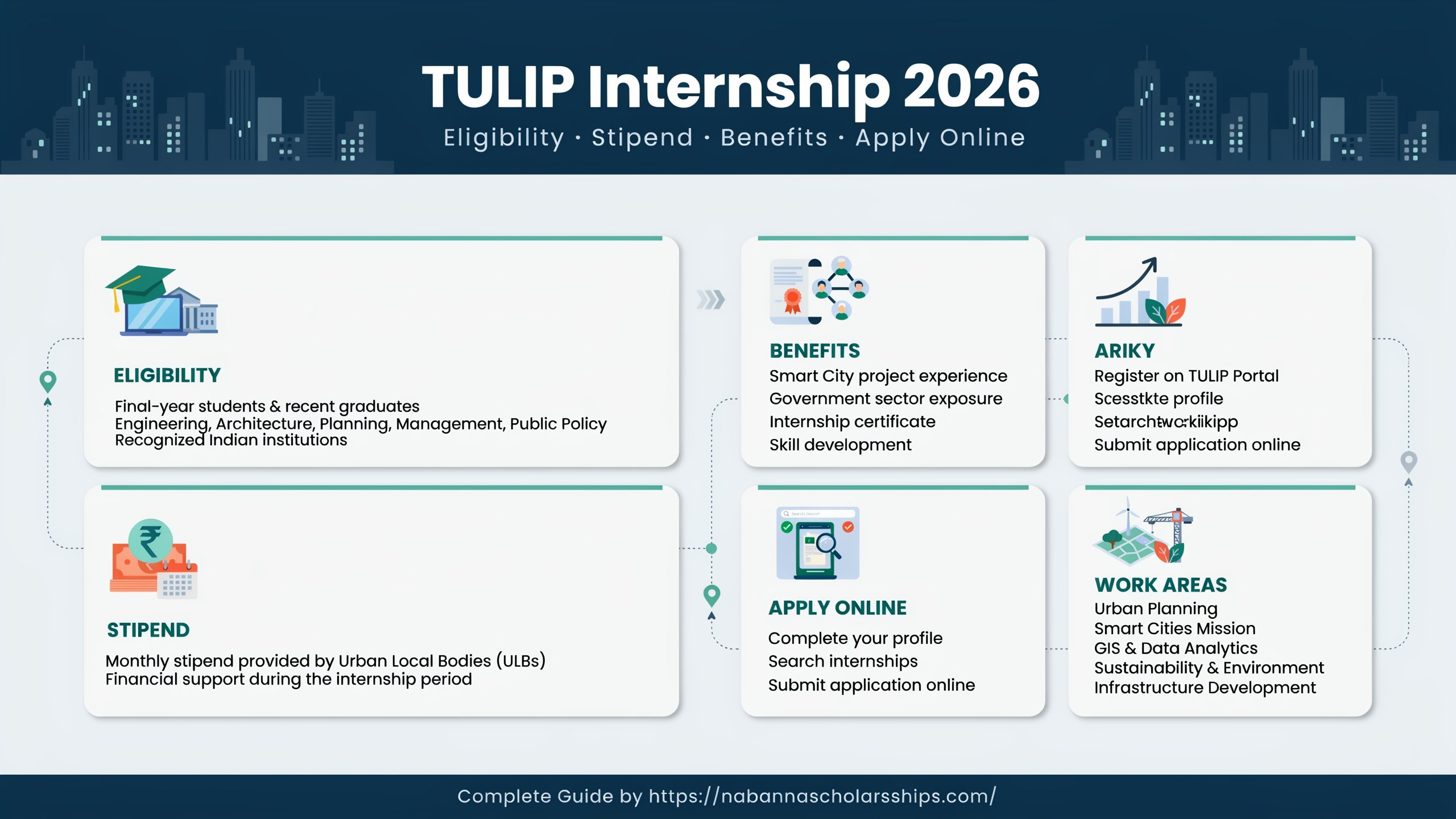
TULIP Internship 2026 eligibility criteria cover final-year students, undergraduate students, postgraduate students, and recent graduates studying at any recognized institution. Whether you’re in UG or PG, the eligibility criteria stay fairly open, and most disciplines connected to urban work are welcome to apply.
Educational Qualifications
Academic qualifications matter here — you need a solid educational background tied to your field, plus proof you’re either currently enrolled or graduated within the last 18 months. Institutions usually ask for transcripts to confirm this before your application moves forward.
Eligible Degree Courses
- Engineering (civil, environmental, or related branches)
- Planning and architecture
- Management
- Law
- Environment and sociology
- Public policy
- Other relevant disciplines tied to urban work
Age Requirements
There’s actually no age limit for this one — no age bar applies, which is a nice change from most government internships I’ve come across that quietly cap you out by your mid-20s.
Nationality Requirements
- Open only to Indian citizens — nationality requirements are non-negotiable
- Reservation policy applies as per standard government norms
- Local policies set by individual urban local bodies (ULBs) may add their own conditions on top
Available Internship Domains Under TULIP
TULIP doesn’t limit you to one field — it spreads internship opportunities across urban governance, infrastructure development, sustainable development, and smart city projects. Wherever you sit in the urban sector, there’s likely a domain here that fits your background.
Urban Planning
This is the core domain TULIP is built around. You could end up assisting with master plans, zoning studies, or city planning decisions, often using planning software the department already relies on for its ongoing urban development projects.
Engineering
- Civil engineering interns often work on roads, drainage, or building projects
- General engineering roles cover utilities, water supply, and similar field work
- Some teams pair engineering interns directly with active infrastructure development projects
Information Technology
- Technology and tech sector roles building dashboards for municipal data
- GIS (geographic information systems) work, mapping everything from drainage lines to land use
- Hands-on time with GIS tools that departments use for daily decisions
Finance and Accounts
Finance roles here usually mean tracking municipal budgets, grants, or project funding. It overlaps a fair bit with public administration and general management, so if numbers and government processes both interest you, this domain blends both pretty naturally.
Project Management
- Coordinating timelines across teams of urban professionals
- Tracking public policy milestones tied to a specific project
- Working closely with management and sometimes architecture teams to keep deliverables on schedule
Environmental and Sustainability Projects
If sustainability is more your interest, this domain covers environment-focused work tied to environmental sciences — things like green cover tracking, waste management, or sustainable development goals woven into ongoing smart cities initiatives.
TULIP Internship Stipend and Benefits
Beyond the resume line, TULIP Internship 2026 backs every paid internship with a monthly stipend, so you’re earning while you learn. Add real work experience and steady skill development on top, and the financial side stops being the only reason to apply.
Monthly Stipend Details
| Aspect | Detail |
| Stipend Type | Paid internship with a fixed monthly stipend |
| Range | Typically ₹5,000 to ₹25,000 per month |
| Basis | Varies by project, duration, and host department |
Internship Certificate
On completion, you get a certificate of completion, but the bigger draw is that it usually comes branded as both an MoHUA certificate and an AICTE certificate — two government names that genuinely mean something on a resume.
Professional Networking Opportunities
- Direct networking opportunities with urban professionals already working in the system
- Regular contact with smart city teams handling live initiatives
- First-hand exposure to how government systems actually function internally
- A real shot at a pre-placement offer (PPO) if the department wants to keep you on
Skill Enhancement Benefits
- Working on live projects and urban development projects sharpens problem-solving fast
- Practical exposure to GIS tools and planning software most students don’t touch until their first job
- Structured professional development that actually translates into career growth later
- A genuine CV enhancement and a stronger LinkedIn profile by the time you finish
- Real industry experience and broad urban sector exposure across more than one department
Skills Required for TULIP Internship
Getting selected is one thing — doing well once you’re in is another. TULIP internships reward a mix of technical know-how, clear communication, sharp problem-solving, and the ability to work smoothly inside a team that’s often larger than what you’re used to.
Technical Skills
- Basic comfort with Excel or Google Sheets for data work
- Familiarity with GIS or mapping tools is a strong plus, even at a beginner level
- Some exposure to planning or design software depending on your domain
- Decent report-writing skills, since most departments expect short written updates
Communication Skills
A lot of internship work involves explaining technical findings to non-technical officials, so being able to simplify your point matters more than sounding impressive. I’ve found that interns who ask clear questions early tend to get assigned better, more interesting work.
Problem-Solving Abilities
Government departments rarely hand you a clean, well-defined problem — you’ll often get a half-finished dataset or a vague brief and have to figure out what’s actually being asked. Being comfortable with that kind of ambiguity, instead of waiting for perfect instructions, makes a real difference.
Teamwork and Collaboration
- Coordinating with officials who have very different working styles than college groupmates
- Sharing credit and updates honestly, since most projects involve multiple interns or departments
- Being reliable on deadlines, even loose ones, builds trust fast in a government setting
Documents Required for TULIP Internship Application
Before you apply, keep your updated resume or curriculum vitae (CV) ready, along with a handful of supporting documents. Most application documents for TULIP Internship 2026 are standard paperwork you’ve likely already used for other student applications.
Educational Certificates
- Graduation certificate or latest mark sheet, depending on your current status
- Other educational documents that confirm your course and institution
- College ID or student ID as proof you’re currently enrolled
Identity Proof
For identity proof, an Aadhaar card works in most cases, though any government-issued ID is usually accepted too. This step exists purely for candidate verification, so make sure the name on your documents matches your application exactly.
Resume/CV
Your resume or CV should be current, not something you wrote for a different internship months ago. A recommendation letter from a professor or previous internship supervisor isn’t always mandatory, but it does strengthen weaker applications.
Passport-Size Photograph
Lastly, keep a recent passport-size photo ready in the standard format most government portals ask for — nothing fancy, just a clear, plain-background shot.
How to Apply for TULIP Internship 2026?
Applying for TULIP Internship 2026 happens entirely through the official portal — specifically the TULIP portal at internship.aicte-india.org. The whole online application process is built to let you apply online without needing to email anyone directly.
Step-by-Step Registration Process
| Step | Action |
| 1 | Start the registration process on the portal |
| 2 | Complete account creation with email and phone verification |
| 3 | Fill in personal details and academic details |
| 4 | Review and confirm before proceeding |
Creating an Account on the Portal
Once your account is live, you build out your candidate profile — basic info, education, and skills. This profile is what organization contact persons actually see when they’re scanning applicants for their listings, so it’s worth filling out properly instead of rushing through it.
Searching Internship Opportunities
- Browse internship opportunities through the internship listings page instead of scrolling endlessly
- Apply a location filter or set your city preferences upfront
- Narrow by duration filter and domain filter to match what you actually want
- Some listings show a skills matching score, which helps you judge your odds before applying
Submitting the Online Application
There’s nothing stopping you from sending out multiple applications across different cities or departments — in fact, it’s a smart move given how competitive the better listings can get. Application submission is final once confirmed, so double-check everything before you hit send.
TULIP Internship Selection Process 2026
The TULIP Internship Selection Process 2026 starts the moment you complete registration on the TULIP portal and create profile details. From there, the application process moves fairly fast, and most candidates know within weeks whether a particular internship opportunity is moving forward for them.
Application Screening
Screening starts with how you apply in the first place — TULIP runs on direct application, meaning you pick internship listings by cities and departments based on genuine candidate interest, not a random lottery system.
Shortlisting Criteria
- Shortlisting happens mainly through resume screening
- A professional resume that’s clearly written tends to clear this stage faster
- Your educational background is checked against the listed selection criteria for that specific listing
Interview or Assessment Process
Not every listing includes an interview or assessment — plenty skip straight to selection — but when one is part of the recruitment process, it’s usually a short, practical conversation rather than a formal grilling, and your candidate profile on the portal often comes up during it.
Final Selection and Joining
Once application review wraps up, you’ll get a confirmation email followed by an offer letter confirming your placement. It’s a fairly transparent process overall, at least compared to other internship programs I’ve seen students go through.
Important Dates for TULIP Internship 2026
There’s no single application period to memorize for TULIP Internship 2026 — applications stay ongoing applications almost all year. Still, knowing the rough application timeline helps you plan around academic semesters instead of applying at the worst possible moment.
Application Start Date
There isn’t one fixed internship start date across the board — it depends on the specific urban local body (ULB) and when they post their listing. Some slots roll out monthly, others come up only when a department has a budget approved.
Last Date to Apply
Since applications run year-round, there isn’t a hard last date to apply for most listings — though a popular smart city project might close early once enough applications come in. Internship duration itself ranges from 2 months to 12 months, so check the listing’s own deadline rather than assuming a fixed cutoff.
Selection Timeline
- Selection timeline usually runs a few weeks from application to decision
- Offer letters typically follow shortlisting and any interview round
- The recruitment schedule can shift depending on how many departments are hiring that month
Internship Commencement Date
Your actual joining date gets confirmed in the offer letter, and it’s usually flexible enough to work around your semester schedule. This is especially true for work from home internships, remote opportunities, and hybrid internships, where there’s no physical desk waiting for you on a strict start day.
Tips to Get Selected for TULIP Internship
Getting picked for TULIP Internship 2026 isn’t about luck — it usually comes down to small, fixable details. A sharper resume, a more specific application, and a little interview prep can move you from “maybe” to “selected” faster than you’d expect.
Building a Strong Resume
- Keep it to one page unless you genuinely have two pages of relevant work
- Lead with projects or coursework tied directly to urban planning, GIS, or policy — not generic college activities
- Quantify wherever possible: “analyzed 200 survey responses” beats “helped with research”
Writing an Effective Application
Generic cover notes get skipped fast. Mention the specific department or city you’re applying to and one concrete reason you want that particular listing — reviewers notice when someone’s clearly read the post instead of mass-applying.
Preparing for Interviews
If a listing does include an interview, expect basic questions about your resume and why urban work interests you, not technical grilling. I’d say the biggest mistake candidates make is not having a clear, honest answer ready for “why this department specifically.”
Career Opportunities After Completing TULIP Internship
Government Sector Opportunities
A strong TULIP stint can open doors into actual government roles later, especially in urban local bodies that remember good interns when hiring for contract positions or junior planning roles.
Smart City Projects
- Many smart city projects prefer candidates who’ve already worked inside a government system
- Familiarity with how municipal departments move (slowly, but predictably) becomes a real advantage
- Some interns get pulled back into the same project as paid consultants later
Private Sector Career Benefits
Private urban consulting firms and infrastructure companies also value this experience, mostly because it proves you can navigate government processes — something most fresh graduates simply haven’t been exposed to.
Common Reasons for Application Rejection
Most rejections under TULIP Internship 2026 come down to small, avoidable mistakes rather than weak profiles. Catching these early can save you from losing a spot you were genuinely eligible for.
Incomplete Documents
Missing even one document — a photo, ID proof, or certificate — is enough to get an application set aside automatically on most portals, no exceptions made.
Incorrect Information
- Mismatched names across documents and the application form
- Wrong academic year or graduation date entered by mistake
- Contact details that bounce back when departments try to reach you
Eligibility Mismatch
Applying to a listing meant for a different discipline or degree level is one of the most common, avoidable rejections. Always double-check the eligibility criteria on the specific listing before applying, since it can vary department to department.
Conclusion
TULIP Internship 2026 isn’t just another line for your resume — it’s a genuine entry point into how Indian cities actually get planned, funded, and managed. Between the paid stipend, real government exposure, and a certificate backed by MoHUA and AICTE, it’s one of the more practical options open to students and fresh graduates right now. If you’re eligible, the smartest move is simple: register early, apply to more than one listing, and treat every project like it actually matters.
TULIP Internship 2026 FAQs
This TULIP section answers the questions students ask most before starting the application process. Whether it’s about the online application on internship.aicte-india.org or basic eligibility, you’ll find quick, straight answers below instead of digging through the full guide.
Is the TULIP Internship paid?
It’s a paid internship, not an unpaid internship — the stipend amount ranges from ₹5,000 per month to ₹25,000 per month.
Who is eligible for TULIP Internship 2026?
Final-year UG students, final-year PG students, and recent graduates from relevant fields at a recognized institution, including Indian students broadly, can apply.
What is the duration of the internship?
Duration varies by listing, but most active internships — including remote internships and hybrid roles — run from a few weeks to several months.
Can final-year students apply?
Yes — final-year students can apply anytime since these are year-round applications, with no fixed last date to apply.
Is a certificate provided after completion?
Yes, you get a certificate of completion once your internship wraps up successfully.
How are candidates selected?
Selection is based on resume screening and eligibility match, and once selected, you’ll get your joining month confirmed in the offer letter.
Can I apply for multiple internship opportunities?
Yes, you can apply across multiple listings — including research roles, design roles, and policy roles — at the same time.