How to Apply for Swami Vivekananda MCM Scholarship?
Applying for the Swami Vivekananda Merit Cum Means Scholarship can feel confusing. Many students fear choosing the wrong directorate, uploading an unclear document, or entering wrong bank details. One error may delay verification, block payment, or lead to rejection.
From my review of the official SVMCM portal, guidelines, user manual, and applicant problems, I found that preparation makes the process easier. Students who check their marks, income certificate, file sizes, and Applicant ID steps before registration face fewer problems.
This guide uses that experience to explain each step in simple words. It covers eligibility, documents, registration, renewal, status tracking, corrections, and payment issues. Follow each step slowly, check details twice, and use only the official government portal for applying online.
Scheme Introduction: A Brief Overview
The Swami Vivekananda Merit Cum Means Scholarship is also known as SVMCM. The Government of West Bengal runs this scheme. It supports meritorious students from low-income families.
| Scheme detail | Information |
| Full name | Swami Vivekananda Merit Cum Means Scholarship |
| Short name | SVMCM |
| State | West Bengal |
| Provider | Government of West Bengal |
| Application mode | Online |
| Normal income limit | ₹2.5 lakh per year |
| Minimum marks | 45% to 60%, based on category |
| Monthly rate | ₹1,000 to ₹8,000 |
| Payment method | Direct Benefit Transfer |
| Official portal | svmcm.wb.gov.in |
The scholarship covers school, college, professional, medical, technical, and research education. The money goes to the student’s bank account through Direct Benefit Transfer (DBT).
Meeting the main rules does not promise selection. Approval depends on merit, correct documents, and available funds.
Key Features of the Scheme
The main features of SVMCM include:
- It is a state-funded scholarship.
- The full application process is online.
- It supports students from economically weaker backgrounds.
- It covers Class 11 through the research level.
- It includes general and professional courses.
- It offers monthly financial support.
- It provides special rules for Kanyashree K3 students.
- It allows fresh and renewal applications.
- It sends money through DBT.
- It does not normally require a hard copy.
- It uses academic merit and income conditions.
- It requires renewal for continuing students.
Students should use only the official portal. Never share your password or OTP.
Who Is Eligible for Swami Vivekananda Scholarship?
An eligible applicant must be a West Bengal resident. The student must study at a recognized institution in West Bengal. The course must meet the scholarship rules.
| Eligibility factor | Main rule |
| Residence | Permanent resident of West Bengal |
| Study mode | Regular course |
| Institution | Recognized institution in West Bengal |
| Academic record | Required marks must be met |
| Family income | Normally up to ₹2.5 lakh per year |
| Bank account | Applicant must provide bank details |
| Documents | Genuine and readable documents |
| Scholarship rule | No second government scholarship for the same course stage |
The official guidelines mention qualifying years from 2021 to 2025. Students from an older qualifying year must meet the stated delay conditions. They may also need a declaration from the Head of Institution.
Basic Eligibility for SVMCM Scholarship
Before applying, check these conditions:
- You live in West Bengal.
- You study in a regular course.
- Your institution is recognized.
- The scheme covers your course.
- You have passed the required examination.
- You have the required marks.
- Your family meets the income rule.
- You have correct bank information.
- You can upload all required documents.
- You know the correct education directorate.
For HS-level applications, candidates from outside the West Bengal Board of Secondary Education are not eligible under the current guidelines.
A. Academic Eligibility Requirements
The academic eligibility depends on the current level of study. Every applicant should check the marks required for their course.
| Study category | Qualifying examination | Minimum marks |
| Higher Secondary | Madhyamik or equivalent | 60% |
| Diploma or polytechnic | Last qualifying exam | 60% |
| General undergraduate | Higher Secondary | 60% |
| Lateral-entry engineering | Approved diploma | 60% |
| General postgraduate | Honours subject | 53% |
| Engineering or technical PG | Graduation | 55% |
| Kanyashree K3 | Graduation | 45% |
| B.Ed. fresh application | Qualifying exam | 53% |
| B.Ed. renewal | Promotional exam | 50% |
A Higher Secondary student normally needs 60% aggregate in Class 10. An undergraduate or UG applicant needs 60% in the Higher Secondary examination.
A general postgraduate (PG) applicant needs 53% marks in the Honours subject. Some engineering courses and technical courses require 55% marks.
Keep these marks rules in mind:
- Additional subject marks may not count for HS selection.
- Optional elective marks may not count for some diploma applicants.
- Lateral-entry students normally need 60% in an approved diploma.
- The institution and diploma must have the required approval.
- The marks entered on the form must match the mark sheet.
B. Family Income Criteria
The normal annual family income limit is ₹2.5 lakh. It includes income from all family sources.
| Income requirement | Details |
| Normal income ceiling | ₹2.5 lakh per year |
| Proof needed | Official income certificate |
| Kanyashree K3 | Income certificate not normally required |
| Board toppers | Income ceiling does not normally apply |
| Eligible research applicants | Income ceiling does not normally apply |
| False information | May lead to cancellation and refund |
Most fresh applicants must upload an official income certificate. The student should use the format provided on the portal.
The certificate may be issued by:
- BDO
- SDO
- Joint BDO
- BLRO in a panchayat area
- Municipal Executive Officer
- Municipal Finance Officer
- Municipal Education Officer
- Commissioner
- Deputy Commissioner
- Municipal Secretary
- Gazetted Officer
False income details can cause serious problems. The scholarship may be cancelled. The student may have to return the money. The student may also lose the right to apply for another government scholarship.
C. Special Category Exemptions
The scholarship offers special conditions for some applicants.
| Special category | Main condition |
| Kanyashree K3 | 45% in graduation |
| K3 income rule | Income certificate not normally needed |
| Female PG student with K2 ID | Complete K2 authentication |
| Female PG student without K2 ID | Apply under DPI |
| Board topper | Separate category rules |
| M.Phil or PhD applicant | Separate research rules |
Students applying under Kanyashree K3 must complete K2 authentication. They need:
- Kanyashree application year
- Kanyashree ID
- Applicant’s name
- Date of birth
- Father’s name
- Mother’s name
Female students in regular PG Science, Arts or Commerce courses can still apply if they do not have a K2 ID. They should use the Directorate of Public Instruction category. Their criteria and benefits are the same as Kanyashree K3.
Who Is Not Eligible for SVMCM?
A student may be an ineligible applicant if:
- The student is not a West Bengal resident.
- The course is not approved.
- The institution is not recognized.
- The marks are below the required level.
- The family income is above the allowed limit.
- The application has false information.
- The required documents are missing.
- The student does not meet the qualifying-year rules.
- The applicant receives another government scholarship for the same course stage.
Minority students should check the separate scholarship route. The official registration page currently directs them to the WBMDFC scholarship portal.
Other SVMCM Scheme Conditions
| Condition | Rule |
| Hard copy | Not normally required |
| Government scholarship | Another scholarship for the same stage is not allowed |
| One-time grant | May be allowed |
| Free studentship | May be allowed |
| False documents | May cause cancellation |
| Study gap | HOI declaration may be required |
| Selection | Based on merit and available funds |
| Bank details | Account number, bank name and IFSC are required |
Students with a study break may need a gap certificate or declaration. The Head of Institution must explain the cause of the gap.
All details must match the applicant’s records. This includes the name, marks, course and bank information.
Courses Covered Under SVMCM
The scheme covers many recognized streams and academic backgrounds.
| Education level | Main courses or areas |
| School | Class 11 and Class 12 |
| General UG | Arts, Science and Commerce |
| General PG | Arts, Science and Commerce |
| Professional UG | Approved UGC professional courses |
| Technical | Engineering, technology and pharmacy |
| Diploma | Approved polytechnic courses |
| Medical | Approved medical degrees and diplomas |
| Teacher training | B.Ed. and D.El.Ed. |
| Research | Eligible full-time M.Phil and PhD categories |
Students should check the approval of their course. The course may need approval from:
- UGC
- AICTE
- Pharmacy Council of India
- Council of Architecture
- State Medical Faculty
- WBSCT&VE&SD
- Another relevant education body
Benefits of the Swami Vivekananda Scholarship
The scholarship can reduce the financial burden on students. It provides monthly financial support based on the course.
| Directorate or course | Monthly rate |
| Higher Secondary | ₹1,000 |
| D.El.Ed. | ₹1,000 |
| UG Arts | ₹1,000 |
| UG Commerce | ₹1,000 |
| UG Science | ₹1,500 |
| Approved UG professional courses | ₹1,500 |
| PG Arts | ₹2,000 |
| PG Commerce | ₹2,000 |
| PG Science | ₹2,500 |
| Approved PG professional courses | ₹2,500 |
| Engineering and approved technical courses | ₹5,000 |
| Medical degree | ₹5,000 |
| Medical diploma | ₹1,500 |
| Non-NET M.Phil | ₹5,000 |
| Non-NET PhD | ₹8,000 |
These are monthly rates. The final scholarship amount depends on the course, approval, study period, and sanction.
Other Benefits of SVMCM
The scheme can help students:
- Continue their education
- Reduce financial pressure
- Meet education-related needs
- Focus on their studies
- Avoid leaving a course due to money problems
- Receive funds without a middle person
- Track the payment through their bank account
The scholarship money goes through DBT. This makes the payment process clearer.
Required Documents
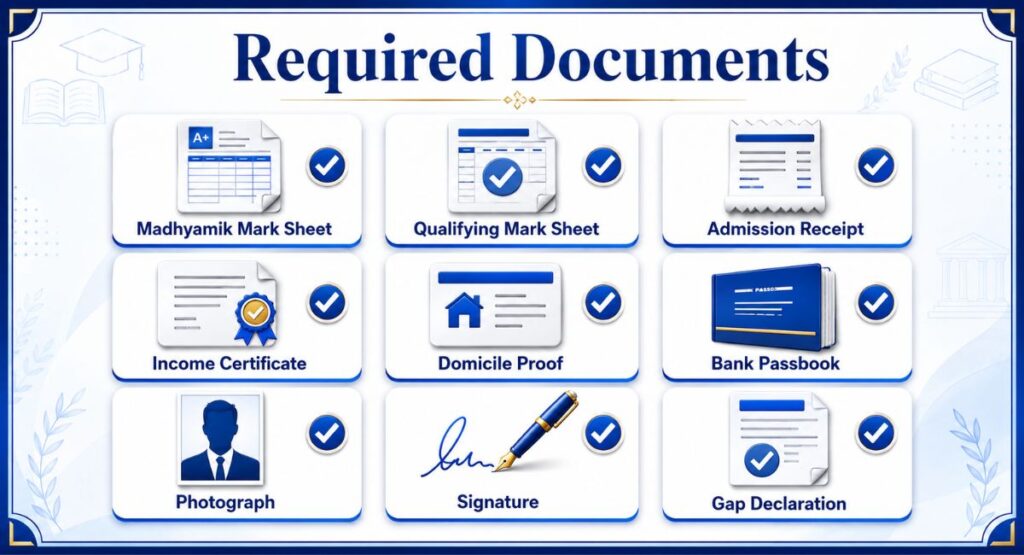
Applicants should prepare every document before starting the form.
| Document | Purpose |
| Madhyamik mark sheet | Checks Class 10 details |
| Latest qualifying mark sheet | Checks academic eligibility |
| Admission receipt | Proves current admission |
| Income certificate | Proves family income |
| Domicile proof | Proves West Bengal residence |
| Bank passbook | Provides account number and IFSC |
| Photograph | Applicant identity |
| Signature | Applicant verification |
| Gap declaration | Explains a study gap |
Accepted domicile proof may include:
- Aadhaar Card
- Voter ID
- Ration Card
- Certificate from a competent authority
The bank passbook must clearly show:
- Applicant’s name
- Account number
- Bank name
- IFSC
- Branch details
Documents for Fresh and Kanyashree Application
Fresh applicants normally need:
- Madhyamik mark sheet with both sides
- Last qualifying mark sheet with both sides
- Current admission proof
- Fee receipt
- Family income certificate
- Domicile document
- Bank passbook first page
- Gap declaration, when required
Kanyashree K3 applicants do not normally need an income certificate.
| Upload item | File format | File size |
| Photograph | JPG or JPEG | 20–50 KB |
| Signature | JPG or JPEG | 10–20 KB |
| Each supporting document | Maximum 400 KB |
Avoid these upload mistakes:
- Blurred scans
- Dark images
- Cut mark sheets
- Wrong file format
- Files above 400 KB
- Missing reverse side
- Wrong document under a field
- Unreadable account details
Documents for Renewal Application
| Renewal type | Required documents |
| Normal renewal | Last examination mark sheet |
| Semester system | Both required semester mark sheets |
| Promotion | Admission receipt for the next class |
| General degree first renewal | Semester 1 and Semester 2 mark sheets |
| General degree second renewal | Semester 3 and Semester 4 mark sheets |
| MBBS first renewal | First MBBS mark sheet |
| MBBS second renewal | Second Professional MBBS mark sheet |
| MBBS third renewal | Third Professional Part 1 mark sheet |
Renewal students must:
- Pass the required exams in the first attempt.
- Apply within one month of admission to the next class.
- Get 60% from HS through UG level.
- Get 50% at the postgraduate level.
- Upload clear academic records.
- Use the previous Applicant ID.
Steps to Apply
The SVMCM application is fully online. Use the official SVMCM portal.
Before starting, keep these items ready:
- Active mobile number
- Working email address
- Academic mark sheets
- Admission receipt
- Income certificate
- Domicile proof
- Bank passbook scan
- Photograph
- Signature
Step 1: Visit the SVMCM Scholarship Portal
Open svmcm.wb.gov.in. Read the notice shown on the home page.
| Current portal detail | Information |
| Session displayed | 2025–26 |
| Fresh application opening date | November 28, 2025 |
| Renewal opening date | November 28, 2025 |
| Fresh Kanyashree K3 opening date | November 28, 2025 |
| Closing date | Not displayed |
Do not treat an expected 2026–27 date as confirmed. Wait for an official notice.
Step 2: Download Guidelines and Accept Terms
Follow these steps:
- Open the official guidelines.
- Read the rules for your course.
- Check the marks requirement.
- Check the income limit.
- Read the document instructions.
- Tick the agreement box.
- Select “Proceed for Registration.”
Step 3: Select Your Directorate Category
| Directorate | Applicant category |
| DSE | Higher Secondary and applicable school students |
| DTE&T | Diploma and polytechnic students |
| DPI | General UG and PG students |
| DTE | Engineering and technical students |
| DME | Medical and nursing students |
| Kanyashree K3 | Eligible female PG students |
Check the institution and course before choosing. A wrong directorate may delay verification.
Step 4: Register and Create Account
During registration:
- Select Fresh Application.
- Enter your name.
- Add your qualifying exam details.
- Enter obtained marks.
- Enter total marks.
- Check the percentage.
- Add an active mobile number.
- Add a working email address.
- Create a strong password.
- Submit the registration form.
Use the same name shown on your academic and bank records.
Step 5: Verify Mobile Number
The portal sends an OTP to the registered mobile number.
After receiving it:
- Enter the OTP.
- Complete OTP verification.
- Wait for the registration message.
- Save the 15-character Applicant ID.
- Download the Registration Slip.
- Check your SMS and email.
- Keep the login credentials safe.
The Applicant ID is needed for login, future messages, status checks, and renewal.
Step 6: Log in to Your Account
To log in:
- Select Applicant Login.
- Enter the Applicant ID.
- Enter the password.
- Complete the CAPTCHA.
- Select the login button.
- Open the applicant dashboard.
If the details are lost, use the “Forgot Applicant ID/Password” option.
Step 7: Complete Basic Details
Enter and check:
- Applicant’s full name
- Date of birth
- Mobile number
- Email address
- Present course
- Institution name
- Admission date
- Academic details
- Photograph
- Signature
The photograph must be 20–50 KB. The signature must be 10–20 KB.
Step 8: Fill Personal Information
Add these details carefully:
- Father’s name
- Mother’s name
- Guardian information
- Residential address
- Domicile information
- Bank account number
- Bank name
- Branch name
- IFSC
Check the bank details twice. Wrong information can stop the payment credit.
Step 9: Upload Supporting Documents
While uploading files:
- Select the correct document field.
- Use PDF format.
- Keep each PDF under 400 KB.
- Upload both sides of mark sheets.
- Make sure every word is clear.
- Choose the income certificate authority.
- Check the bank passbook scan.
- Add the gap declaration if required.
Step 10: Review and Submit
Before final submission:
- Open the application in view mode.
- Check the applicant’s name.
- Check the marks.
- Check the course.
- Check the institution.
- Check the income details.
- Check the bank information.
- Review all uploaded documents.
- Select final submission.
- Download the application copy.
Direct editing is normally not available after submission.
| Correction type | Who may help? |
| General form or document error | Head of Institution |
| Renewal bank details | Concerned directorate |
| Course name | Official helpdesk |
| Institution name | Official helpdesk |
| Admission date | Official helpdesk |
| Locked application | Head of Institution |
How to Renew Swami Vivekananda Scholarship?
A renewal applicant should not register again.
Follow these steps:
- Visit the official portal.
- Select Applicant Login.
- Enter the previous Applicant ID.
- Enter the password and CAPTCHA.
- Open the Renewal Application.
- Add the latest marks.
- Upload the required mark sheets.
- Upload the new admission receipt.
- Check the bank details.
- Review and submit the form.
| Renewal rule | Requirement |
| Registration | New registration is not needed |
| Login | Use the previous Applicant ID |
| Submission period | Within one month of new admission |
| Exam attempts | Pass in the first attempt |
| HS to UG marks | Minimum 60% |
| PG marks | Minimum 50% |
Swami Vivekananda Scholarship Deadline
The application timeline can change each year. Fresh, renewal, and Kanyashree dates may differ.
Students should:
- Check the official portal often.
- Read the latest notice.
- Avoid unofficial deadlines.
- Prepare documents early.
- Submit before the official closing date.
- Avoid waiting until the final day.
- Save the submission copy.
The current schedule shows November 28, 2025, as the opening date. It does not display a closing date. No 2026–27 date should be called official until the government confirms it.
Swami Vivekananda Scholarship Selection Process
| Selection stage | What happens? |
| Application submission | The student submits the form |
| Institution check | The school or college reviews it |
| Income check | The authority checks family income |
| Document check | Uploaded records are reviewed |
| Academic check | Marks and course are checked |
| Merit list | Applications are arranged by merit |
| Directorate review | The department reviews the form |
| Final approval | Eligible applications receive approval |
| Payment | Money goes to the bank account |
Selection may depend on:
- Academic performance
- Financial background
- Correct documents
- Institution verification
- Course approval
- Correct directorate
- Merit position
- Available funds
How to Check SVMCM Status?
To check the SVMCM status:
- Open the official portal.
- Select Applicant Login.
- Enter the Applicant ID.
- Enter the password.
- Complete the captcha.
- Open the dashboard.
- Select application status.
- Read the full status message.
If the form stays pending, contact the institution first. Ask whether it has checked and forwarded the application.
What Does Your Swami Vivekananda Scholarship Application Status Mean?
| Status type | General meaning |
| Submitted | The portal received the form |
| Institution review | The school or college is checking it |
| Forwarded | The institution sent it to the authority |
| Directorate review | The department is reviewing it |
| Approved | The application received approval |
| Payment progress | The bank-transfer process has started |
| Rejected | A required condition was not met |
The exact words may differ on the portal. Read the message shown on the applicant dashboard.
Important Forms
Applicants may need:
- Official income-certificate format
- HOI forwarding letter for board toppers
- Study-gap declaration
- Claim certificate for research applicants
- Utilization certificate
- Research progress report
| Research application item | Requirement |
| Registration | Institution registers eligible Non-NET applicant |
| Photograph | JPG or JPEG, 20–50 KB |
| Signature | JPG or JPEG, 10–20 KB |
| Class 10 proof | Mark sheet or admit card |
| Bank proof | Blank cancelled cheque |
| Research proof | M.Phil admission or PhD registration |
| Renewal | Claim certificate and progress report may be required |
| Bank details | Institution enters details before verification |
Research students should follow the separate instructions on the official portal.
Relevant Links
- Official SVMCM portal
- Official application procedure
- Official eligibility and scholarship rates
- Official registration page
- Official SVMCM user manual
Contact Information
| Support option | Details |
| Official helpline | 1800-102-8014 |
| Helpdesk email | helpdesk.svmcm-wb@gov.in |
| Official portal | svmcm.wb.gov.in |
| Other support | Online grievance registration |
Before contacting support:
- Keep the Applicant ID ready.
- Note the exact error message.
- Keep the registered mobile number ready.
- Explain the problem clearly.
- Do not share the password.
- Do not share the OTP.
For a failed payment, contact the institution or concerned directorate. The official guidelines state that failed-transaction corrections for the previous financial year must be completed at the directorate level by June 30 under IFMS rules.
Conclusion
Applying for the Swami Vivekananda MCM Scholarship becomes easier when you prepare first. Keep your marksheets, income certificate, admission receipt, domicile proof, and bank passbook ready. Choose the directorate, follow each step, and review details before final submission.
From my review of official SVMCM rules and the application process, problems come from wrong bank details, poor scans, incorrect categories, and lost login information. Saving the Registration Slip and Applicant ID can prevent stress during status checks and renewal.
My research shows that students should never trust an unofficial deadline or application link. Check the government portal for current dates. If a problem appears, contact your institution, directorate, or official helpdesk. Careful action gives your application a stronger chance of approval.
Frequently Asked Questions?
What is the Swami Vivekananda Scholarship?
The Swami Vivekananda Scholarship is a merit-cum-means scheme. It helps eligible students in West Bengal.
How do I apply for the Swami Vivekananda MCM Scholarship?
Register on the official portal. Verify your mobile number. Log in, complete the form, upload the documents, and submit it.
What is the maximum family income for SVMCM?
The normal family income limit is ₹2.5 lakh per year. Some special categories have exemptions.
How much money does SVMCM provide?
The official monthly rate ranges from ₹1,000 to ₹8,000. The course decides the rate.
Can I apply after a one-year study gap?
You may apply if you meet the qualifying-year rules. You may also need a declaration from the Head of Institution.
Can I edit my SVMCM application after submission?
You cannot normally edit it yourself. Ask the Head of Institution to unlock it when the rules permit a change.
What should I do if my application is rejected?
Check the reason on the dashboard. Contact your institution. Correct the details if the form can be unlocked.
Why has my scholarship money not arrived
Verification may still be pending. Wrong bank details or a failed transaction may also delay payment.
Can I receive SVMCM with another government scholarship?
You cannot normally receive another government scholarship for the same course or study stage.
How can I recover my Applicant ID or password?
Use the “Forgot Applicant ID/Password” option on the official login screen. Complete the required verification.