
CUET UG 2026 Complete Guide: Dates, Eligibility, Pattern and Admission
The Common University Entrance Test, commonly known as CUET UG, is a national-level entrance exam conducted by the National Testing Agency, or NTA, for undergraduate admission in India. It was introduced to simplify the university entrance and admission process for students from various educational backgrounds. Through this single entrance test, candidates can seek admission to different undergraduate programs and programs offered by central universities, state universities, deemed universities, and private universities.
From my experience reviewing entrance systems, CUET provides a more consistent assessment platform than relying only on school marks. Its standardized assessment platform supports standardized assessment, educational assessment, and fair assessment at the national-level. This approach helps universities manage university admission through a clearer selection process, while encouraging a fair selection process, transparent selection process, and transparent selection for learners with different educational backgrounds. The final assessment allows institutions to compare applicants for their chosen courses more fairly.
Why CUET UG Was Introduced
CUET UG creates a common platform for university admission, giving students wider admission opportunities through one single entrance test. In my experience, this centralized admission model improves student access, supports fair assessment, and reduces unfair score dependency across higher education.
- The main objective is to help applicants apply to multiple universities through a common entrance test, making university applications and multiple applications easier.
- It supports undergraduate courses, simplifies course admission, and creates a clearer admission process for better university selection.
- CUET aims to reduce dependency on board exam scores and board examinations, allowing academic merit to receive greater importance.
- A consistent assessment system strengthens the selection process, merit-based selection, and overall merit-based selection process.
- This entrance examination promotes a transparent process and transparent selection, while the single test makes admission simpler.
CUET UG 2025 Schedule, Exam Dates, and Fee Details
For CUET (UG) – 2025, candidates should track the application window, fee payment deadline, correction window, exam dates, and result declaration carefully. From experience, saving the official website and checking the NTA website regularly prevents missed updates during the admission cycle.
| Key area | Important details |
| Exam overview | The Common University Entrance Test, also called CUET UG or CUET (UG), is a national entrance test conducted by NTA for admission and undergraduate admission to Undergraduate Programmes at Central Universities, CUs, participating Universities, and other participating institutions. It serves students in India and operates across India during the academic session and academic year 2025-26. |
| Test choices | CUET is conducted in 13 mediums, so applicants should check the exam medium, available languages, and language subjects. The General Aptitude Test measures general aptitude. The subject selection process permits a maximum of five subjects or five (05) subjects, while the number of subjects and subjects chosen affect the payable amount. |
| Application dates | The Online Submission of Application Form and online application begin on 01 March 2025. The application process remains open until 22 March 2025, upto 11.50 PM. This is the Last date for the main form submission. |
| Fee payment | A successful transaction must be completed by 23 March 2025 using approved payment methods, including Credit Card, Debit Card, Net-Banking, and UPI. |
| Correction dates | Correction in Particulars opens on 24 March 2025 and closes on 26 March 2025. Applicants should use this period to review their application particulars. |
| Exam city and admit card | The Announcement of the City of Examination, examination city, exam centre details, Downloading Admit Cards, and admit cards are To be announced later on the website. Check the website and exam notification regularly. |
| Examination period | The Date of Examination is Between 08 May and 01 June 2025. The 08 May 2025 starting date and 01 June 2025 closing date form a tentative schedule. |
| Responses and results | The Display of Recorded Responses, Recorded Responses, response sheet, Answer Keys, and answer key release will appear later. The Declaration of Result and result announcement are also To be announced later on the website. |
| Fee categories | The fee structure depends on Category, candidate category, and reservation categories. It covers General (UR), OBC-NCL, EWS, SC, ST, PwD, PwBD, and Third gender. |
| Fees within India | For Up to 03 Subjects, the application fee is ₹ 1000 for General (UR), ₹ 900 for OBC-NCL and EWS, and ₹ 800 for SC, ST, PwD, PwBD, and Third gender. Each Additional Subject carries an additional subject fee of ₹ 400 each, ₹ 375 each, or ₹ 350 each. The subject-wise fee, total fees, and fee calculation depend on the selected papers. |
| Fees outside India | Centres outside India and international examination centres charge ₹ 4500 for the base combination and ₹ 1800 each for every extra subject. |
CUET UG 2025 Exam Pattern and Key Features
The CUET UG 2025 framework explains the total subjects, exam mode, medium, syllabus, Marking Scheme, and Duration clearly. In my experience, understanding the choice of test paper, subject selection, and multiple examination shifts early makes preparation more focused and manageable.
| Feature | Details |
| Registration process | Registration is completed through online registration on the online application portal at https://cuet.nta.nic.in for CUET (UG) – 2025. |
| Subjects and paper choice | The exam offers 37 total subjects under the listed total subjects: 13 languages, 23 domain-specific subjects, and 01 General Aptitude Test. The available domain-specific subjects and domain subjects are included across different test papers. Candidates may select five (05) subjects, meaning a maximum of five subjects or five (05) papers, including a Language paper and the General Aptitude Test. This rule applies irrespective of subjects opted in class XII, so the selected subjects opted do not have to match class XII. |
| Languages and medium | The medium covers 13 Indian languages across 13 mediums. These Indian languages are Assamese, Bengali, English, Gujarati, Hindi, Kannada, Malayalam, Marathi, Punjabi, Odia, Tamil, Telugu, and Urdu. This wide language choice helps students select a suitable option. |
| Language syllabus | Under Language Subjects, the Language to be tested includes a language test based on Reading Comprehension, reading skills, and different types of passages. These passages include Factual passages, Literary passages, and Narrative passages, along with Literary Aptitude, Vocabulary, and literary aptitude and vocabulary. |
| Domain and aptitude syllabus | The NCERT syllabus is followed as per NCERT syllabus for domain papers. The General Aptitude section covers General Knowledge, Current Affairs, General Mental Ability, Numerical Ability, and Quantitative Reasoning. It uses the simple application of basic mathematical concepts, including arithmetic, geometry, mensuration, and statistics, along with Logical and Analytical Reasoning, logical reasoning, analytical reasoning, and mathematical reasoning. |
| Questions and duration | The Total Questions are 50 questions in each test paper. The question paper has all Question are compulsory, meaning all questions compulsory with no optional items among the compulsory questions. The test paper duration is 60 minutes for every test paper. |
| Exam mode and shifts | The examination follows Computer Based Test (CBT) mode. It may run in multiple shifts, exam shifts, or multiple examination shifts, depending on the number of Candidates, their subject choices, and the final exam schedule. |
- Under the Marking Scheme, a Correct Answer or each correct answer earns 05 marks, also written as five marks.
- There is negative marking for an incorrect answer. each incorrect answer leads to a deduction of 01 mark, also stated as one mark.
CUET UG Registration Documents and Payment Details
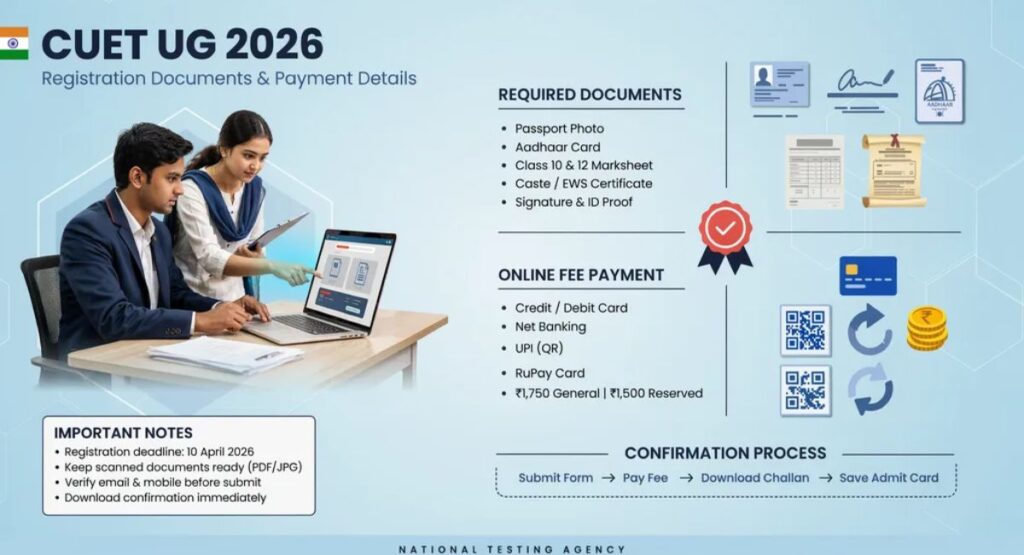
Preparing the correct files before online registration prevents payment and submission problems. From experience, checking every document upload, file format, and fee step early makes the registration process smoother, protects application status, and helps candidates receive a valid Confirmation Page.
| Requirement | Details |
| Registration checklist | The registration documents should include complete candidate details and follow all document requirements and upload guidelines. Keep the scanned documents ready before form submission or application submission to support application completion and a successful application. |
| Photograph | For the Photograph, upload a Recent passport-size photo or passport-size photograph with 80% face visible, also described as 80 percent face visibility. Use a white background or white-background photo and follow the photo specifications. |
| Photograph size and format | The accepted file size is 10 KB – 200 KB, beginning at 10 KB and ending at 200 KB. The image can be submitted in JPG, JPEG, or JPG/JPEG format. |
| Signature | For the Signature, provide a scanned signature or scanned signature file. Follow the signature specifications and keep the document within 10 KB – 50 KB, with a maximum size of 50 KB. |
| Disability certificate | For a PwD Certificate, if applicable, upload a Scanned PwD/PwBD/UDID certificate. This disability certificate may cover PwD, PwBD, or a UDID certificate. Follow the certificate specifications and certificate upload rules. |
| Certificate size and format | The accepted size is 50 KB – 300 KB, with a maximum of 300 KB. The certificate should be uploaded as a PDF or in PDF format. |
| Online fee methods | Under Fee Payment, the candidate must pay the requisite examination fee and prescribed application fee through online fee submission. The application fee payment and examination fee can be completed through online payment or an online transaction using Net Banking, Credit Card, Debit Card, or UPI. |
| Additional charges | The concerned Bank or Payment Gateway Integrator may add processing charges, payment gateway charges, bank charges, tax charges, applicable charges, and GST. These costs are charged separately from the main fee remitted. |
| Successful payment | The online Application Form or Application Form becomes complete after a successful transaction, successful fee transaction, successful payment, successful payment receipt, payment receipt, fee receipt, or receipt. |
| Application confirmation | A successful remittance creates payment confirmation, application confirmation, candidature confirmation, and confirmed candidature. The applicant’s candidature is confirmed only after the fee reaches the payment system. |
| Confirmation Page | The page is generated after payment and is downloadable only after successful remittance. When the Confirmation Page not generated issue appears, approach the concerned Bank or Payment Gateway for assistance. |
| Payment support | Use the helpline number, candidate helpline, e-mail, email support, or payment gateway support provided in the Information Bulletin to ensure successful payment. The same support may also be available through the payment gateway. |
| Duplicate payments | For a duplicate payment, multiple payment, duplicate payments, or multiple payments, contact the bank about the refund process, refund of duplicate payments, or refund of multiple payments. |
| Refund rule | The refund policy states that no request for refund will be accepted by NTA once payment is completed under any circumstances. Therefore, applicants should verify the amount before requesting a refund. |
| Final registration steps | All 3 Steps may be completed together or at separate timings. After the submission of the Application, Download, save, and print an application form copy or copy of the Confirmation Page for future reference and future use. |
Who Can Apply for CUET UG 2026?
Applicants should check university requirements before applying for CUET UG 2026, while using CUET UG 2025 only as a reference. In my experience, early eligibility verification prevents mistakes and keeps the application review process clear, accurate, and stress-free for students.
| Eligibility area | Simple explanation |
| Basic rule | Under Age Limit, there is no age limit for the current test. A candidate may apply after passed Class 12 or while appearing for Class 12. This covers completed Class 12, appearing candidates, Class 12, Class XII, 10+2, secondary education, and an accepted school-leaving qualification. |
| Recognized school examinations | The accepted qualifying examinations include a final examination from a recognized Central or State Board, a Central or State Board, Central Board, or State Board. Common references include CBSE, ICSE, a recognized board, a recognized exam, and a regular board examination. A Senior Secondary School Exam from the National Institute of Open Schooling, also called NIOS, is accepted with five subjects. This route also covers Open Schooling, a public board exam, a Class 12 public exam, a public examination, and the Board level. When Class 12 was not public, the student should have at least one public exam, such as an earlier public exam at the Pre-University level. |
| Other Indian qualifications | Eligible routes may include an Intermediate examination, a 2-year Pre-University Course, or a Pre-University examination. They also include the Final exam of the Joint Services Wing at the National Defence Academy, described as the National Defence Academy examination. Other options include the Higher Secondary Certificate Vocational Examination, a vocational examination, and a diploma qualification. A three-year diploma of at least 3 years may be recognized by AICTE, the State Board of Technical Education, or a Technical Education Board within technical education. |
| International qualifications | Accepted routes may include General Certificate Education, or GCE, at the Advanced A level from London, Cambridge, or Sri Lanka. They may also include the Cambridge University High School Certificate Exam, an International Baccalaureate Diploma, or IB Diploma from Geneva. |
| Equivalent examinations | For an exam abroad, study abroad, a foreign qualification, an international qualification, a foreign board, or a foreign board qualification, the examination must be equivalent to Class 12. Recognition terms include equivalence certificate, AIU, Association of Indian Universities, AIU equivalence, and equivalence from AIU, alongside a recognized university, recognized qualification, exam in India, or education completed in India. Applicants should verify the authority stated in the current bulletin. |
| University conditions | Every University, Institution, or Organization may set unique eligibility criteria. Applicants should read the rules of the respective University or respective institution on the university website, University website, and check the university’s website for university eligibility rules, university-specific requirements, specific age requirements, a university-specific age limit, and respective eligibility requirements. |
| Admission policies | The applicable existing policies may cover quota policy, category policy, relaxation rules, reservation policy, qualification policy, preference rules, admission policies, reservation rules, quota, category, relaxation, reservations, qualification, and preferences. Students must also review subject combinations, subject eligibility, programme-wise requirements, Programme-wise eligibility conditions, respective programmes, programme admission, and admission to the Programme. |
| Applicant’s responsibility | Before submission, check admission eligibility, application eligibility, academic eligibility, educational qualification, qualification requirements, candidate eligibility, and general eligibility criteria. It is part of candidate responsibility to possess eligibility criteria, confirm that the applicant fulfills eligibility conditions, obtain eligibility confirmation, and verify the year of completion and Class 12 completion year before applying. |
| Admission outcome | The Entrance Test is a National-level entrance exam used for university admission and undergraduate admission. However, mere appearance does not guarantee admission consideration. All candidates must satisfy the programme and university rules listed under Who Can Apply. |
- The supplied keyword set contains older labels: CUET (UG) – 2025, 2025, appearing in 2025, and apply for CUET UG 2025. Treat them as previous-year references rather than current 2026 instructions.
- Applicants should follow the official 2026 bulletin because eligibility can differ by university, programme, subjects, reservation rules, and year of appearance.
CUET Reservation Rules and PwD Support
Understanding reservation policies and special provisions helps applicants avoid mistakes during registration. In my experience, early document verification, correct application category selection, and clear knowledge of PwD/PwBD provisions make the exam process fairer, safer, and easier for every eligible candidate.
| Area | Simplified details |
| Reserved categories | The reservation for categories provides reserved seats for eligible Indian nationals and Indian citizens. Categories include OBC-NCL, or Other Backward Classes under the Non-Creamy Layer; Gen-EWS, or Economically Weaker Section; SC, or Scheduled Caste; and ST, or Scheduled Tribe. |
| Applicable policies | The reservation rules may follow the Government of India, national reservation policy, and central rules. A State Government, different State Governments, or respective State Governments may apply State Government rules, the State Government’s reservation policy, state reservation policy, state rules, and state policy applicability to state-run institutes and state-run institutions. |
| PwD/PwBD meaning | persons with disabilities, candidates with disabilities, PwD, PwBD, and PwD/PwBD candidates may qualify through a government-certified disability. The condition must be verified by a government authority through government certification and usually involve at least 40% disability, a 40 percent benchmark disability, or another recognized benchmark disability. |
| Covered impairments | A long-term impairment may include a physical impairment, mental impairment, intellectual impairment, or sensory impairment. This includes long-term physical impairment, long-term mental impairment, long-term intellectual impairment, and long-term sensory impairment affecting a person’s ability to participate in society and maintain full societal participation. |
| Required proof | Applicants should upload documents, including a valid disability certificate, disability certificate, valid certificate, UDID card, or Unique Disability Identification card. The reservation document, application form, and application submission may also require medical proof, a medical certificate, or medical confirmation. Proper checking supports reservation compliance and remains the candidate responsibility. |
- Scribe support: Applicants with blindness, cerebral palsy, severe locomotor disabilities, both arms affected, or another locomotor disability may request a scribe, writer/assistant, writer, or assistant. This provides exam assistance, writing support, special facilities, special accommodation, exam accommodation, and disability support for candidates with writing limitations or a writing disability.
- Using a personal scribe: A candidate may bring an own scribe, but the scribe qualification must usually be one level below the candidate qualification or candidate’s qualification. Applicants must meet scribe eligibility and eligibility for scribe, submit scribe details, provide complete scribe details, and follow the official format or official scribe format for the use of scribe.
- Extra-time entitlement: Eligible candidates receive compensatory time, extra time, or an extra time facility of at least 20 minutes per hour. The minimum compensatory time can include a minimum of 1 extra hour or an extra hour during a 3-hour exam, also described as a three-hour examination.
- Shorter papers: When the exam duration is shorter than an hour, time is calculated on a proportional basis, with at least minimum 5 minutes. The same principle applies when comparing a shorter paper with a full one-hour examination.
- Category details: Applicants must correctly select their category, sub-category, category/sub-category, and reservation category for CUET UG 2025. After the CUET UG 2025 scores, score announcement, or NTA score declaration by NTA, a category change restriction may prevent any post-result category change.
- False claims and misuse: A false disability claim, false disability claim, use of fake documents, fraudulent documents, or reservation fraud to obtain reservation benefits may lead to disqualification. The same applies to misuse of scribe or misuse of extra time.
- Admission consequences: Penalties may include removal from evaluation, ranking, counseling, and admission through evaluation disqualification, ranking disqualification, counseling disqualification, and admission disqualification. If a student is already admitted, the result may be admission canceled, admission cancellation, or complete cancellation of admission.
CUET UG Admit Card Rules and Exam-Day Checklist
Before exam day, review CUET UG 2025 admit card instructions carefully. In my experience, checking the printed admit card, identity proof, reporting details, and Mandatory Items early prevents last-minute problems and helps candidates enter the examination centre calmly and correctly.
| Area | Simple guidance |
| Availability | The National Testing Agency provides the Admit Card through online only admit card availability after the official admit card release. Complete the admit card download through online download from the official NTA website, NTA website, or official website at https://cuet.nta.nic.in. It is a self-download, so download it yourself because it is not sent by post and there is no postal delivery. |
| Exam information | Check the candidate information, candidate name, candidate photograph, candidate signature, exam center, exam centre, exam location, examination venue, exam date, exam time, and complete exam schedule. These details support candidate identity, identity verification, exam permission, and smooth exam centre entry, exam hall entry, and exam entry for the entrance examination or admission test. |
| Printing and safety | Use Download & Print to create a clear printout, admit card print, or A4-size print on A4 paper. Follow document safety, safe storage, admit card preservation, and keep it safe for future reference and post-exam reference after the exam. There are No Duplicate Admit Cards, and a lost card may not have a replacement admit card or duplicate copy at the centre. |
| Errors and corrections | Under Correct Details, inspect the card for incorrect details, admit card discrepancy, name mismatch, photo mismatch, or signature mismatch. For name correction, photo correction, or signature correction, contact NTA during NTA contact hours or the stated helpdesk timing of 10 AM – 5 PM. You may use the current Admit Card while waiting for an NTA correction, according to the stated instructions. |
| Entry conditions | No Admit Card = No Entry. An incomplete application, unfinished application completion, invalid application status, unmet eligibility requirements, weak candidate eligibility, or missing eligibility compliance may prevent the card from being issued. Following the admit card rules and all exam instructions remains the candidate responsibility. |
| Mandatory papers | Under What to Bring on Exam Day, use the exam-day checklist and carry the admit card with the Self-Declaration Form, also called the declaration form, downloaded from NTA website. Keep these exam day documents, each mandatory document, and all required original documents ready for document verification, exam attendance, and attendance verification. |
| Photograph and pen | Bring one extra passport-size photo or passport-size photograph, ideally the same as uploaded in the application or matching the application photo, for the attendance sheet and attendance record. Carry a simple pen, preferably a transparent ballpoint pen or transparent pen. |
| Valid identity proof | Carry one valid photo ID from the permitted valid photo IDs list. It must be an original photo ID, photo ID proof, valid identification, government ID, or other approved photo identification that is original and non-expired, a non-expired ID, and with photo. |
| Accepted IDs | Accepted options include a School ID Card for school identification, PAN Card, Passport, Aadhaar Card, E-Aadhaar, Class 12 Board Admit Card, another board admit card, or Bank Passbook as a bank identity document. |
| PwD document | Carry a PwD Certificate or another approved disability certificate if applicable. This supports the required medical accommodation and related entry checks. |
| Diabetic candidates | Diabetic Candidates or a diabetic applicant may carry approved permitted food items, such as sugar tablets or fruits, including banana, apple, or orange. |
| Prohibited materials | electronic devices, electronic gadgets, written notes, notes, personal bags, and other bags are not allowed. Treat them as restricted materials and prohibited items because they may affect exam security. |
- Do not write, do not tear, or do not change anything on the card; tampering prohibited applies throughout the process.
- Keep the card clean and readable to avoid delays during verification.
How CUET Scores Lead to Admission?
Understanding CUET scoring and the admission process helps students avoid confusion after the exam. In my experience, checking the final answer key, scorecard, merit list, counseling schedule, and university rules early makes the process clearer, safer, and easier to follow properly.
| Area | Simple explanation |
| MCQ marking | This multiple-choice scoring method uses the marking scheme for Multiple Choice Questions or MCQs. A correct answer, one correct answer, correct option, or correct response earns +5 marks, also described as five marks. A wrong answer or incorrect response receives -1 mark, which is a one-mark deduction. An unanswered question, unattempted question, or blank response gets 0 marks or zero marks. The system checks each question response and attempted question during the final answer evaluation. |
| Special question cases | In special cases, when there are multiple correct options or more than one correct answer, choosing any valid answer may earn bonus marks. If there is an incorrect question, question dropped, dropped question, or question cancellation, all candidates and all examinees may receive marks, attempted or not and whether attempted or not. |
| Shift adjustment and NTA score | When the test runs in different exam shifts or multiple shifts, NTA may use score adjustment, marks adjustment, score normalization, and marks normalization to support fairness. The final normalized score becomes the NTA Score. Its NTA Score calculation, score calculation, and result calculation determine the candidate score, CUET score, and entrance test score shown after the exam. |
| Score validity | The CUET (UG) scores and NTA score validity apply to the stated score validity period. For CUET (UG) 2025, the score validity covered the 2025-26 academic year, also called the admission year 2025-26 or academic year. The supplied wording UET (UG) 2025 score relates to the same cycle, while CUET UG remains the correct exam name. |
| Result and answer key | The evaluation process, result evaluation, and result evaluation and rechecking depend on the answer key. After the answer key announcement, final answer key announcement, final key, and final answer are issued, the final answer key result, final result, examination result, result announcement, and score announcement become available. |
| Rechecking policy | Once results are final, no complaints accepted applies to answer complaints, with a clear complaint restriction. There is no re-evaluation, no rechecking, result rechecking, or no revaluation after the announced result. |
| Scorecard access | Students must use the result portal, result checking, online result, and NTA website for the online scorecard, scorecard download, and score download. The scorecards are not sent by post, so there is no postal delivery. |
| Admission conditions | A good score supports score-based admission, score-based selection, candidate selection, admission selection, and merit-based selection, but it is not an admission guarantee. The UET (UG) 2025 score does not guarantee admission, meaning there is no admission guarantee based only on marks. Final admission consideration, admission decision, admission outcome, application outcome, candidate admission status, and admission status depend on other checks. |
| Eligibility and verification | Universities review admission criteria, other admission criteria, institutional criteria, other criteria, and rules based on other criteria. They also check university eligibility criteria, eligibility requirements, candidate eligibility, admission eligibility, medical eligibility, medical fitness, medical examination, and medical verification. Applicants may need original documents, original document verification, original document authentication, document verification, document authentication, and full admission criteria verification. |
| University merit and counseling | The process lets each university manage its university admission, university-specific admission, institutional admission, academic admission, undergraduate admission, and candidate admission. It may publish a university merit list through merit list preparation, release merit list, merit ranking, merit ranking list, merit list and ranking, and general ranking. It also controls the release counseling schedule, admission schedule, counseling process, university counseling, and university counseling process. |
| NTA and university roles | The National Testing Agency has an NTA role in conducting the exam and publishing scores, but it has no role in preparing merit lists and no role in admissions. Universities manage their own admissions, while the admission authority, admission handling authority, and local teams control admission handling. |
| Where scores may be used | The score may be used by participating universities, participating institutions, other universities, and other organizations according to their own rules. They decide the use of CUET scores, admission based on CUET scores, CUET score use, and wider score use. Students should check the chosen university, its official university website, university website, and official website for official details, admission information, admission procedures, and the current admission cycle. |
| Rules and official resources | Follow all admission rules and the selected institution’s university rules. Useful resources include the CUET UG official site, CUET OFFICIAL SITE, and CUET UG syllabus. |
| Contact details | Under CUET UG Contact Details, use the NTA Helpline, helpline number 011-40759000, or the contact email and email support address cuet-ug@nta.ac.in for official help. |
Conclusion
CUET UG gives students a single, transparent route to apply for undergraduate admission across participating universities. Understanding the eligibility rules, exam pattern, required documents, reservation benefits, admit card instructions, marking scheme, and important dates can prevent common application mistakes. Careful preparation also helps candidates manage the registration and examination process with greater confidence.
However, a strong CUET score alone does not guarantee admission. Each university follows its own eligibility criteria, merit list, counselling schedule, document verification, and reservation policy. Candidates should regularly check official NTA and university websites, keep all records safe, and complete every step before the stated deadline.